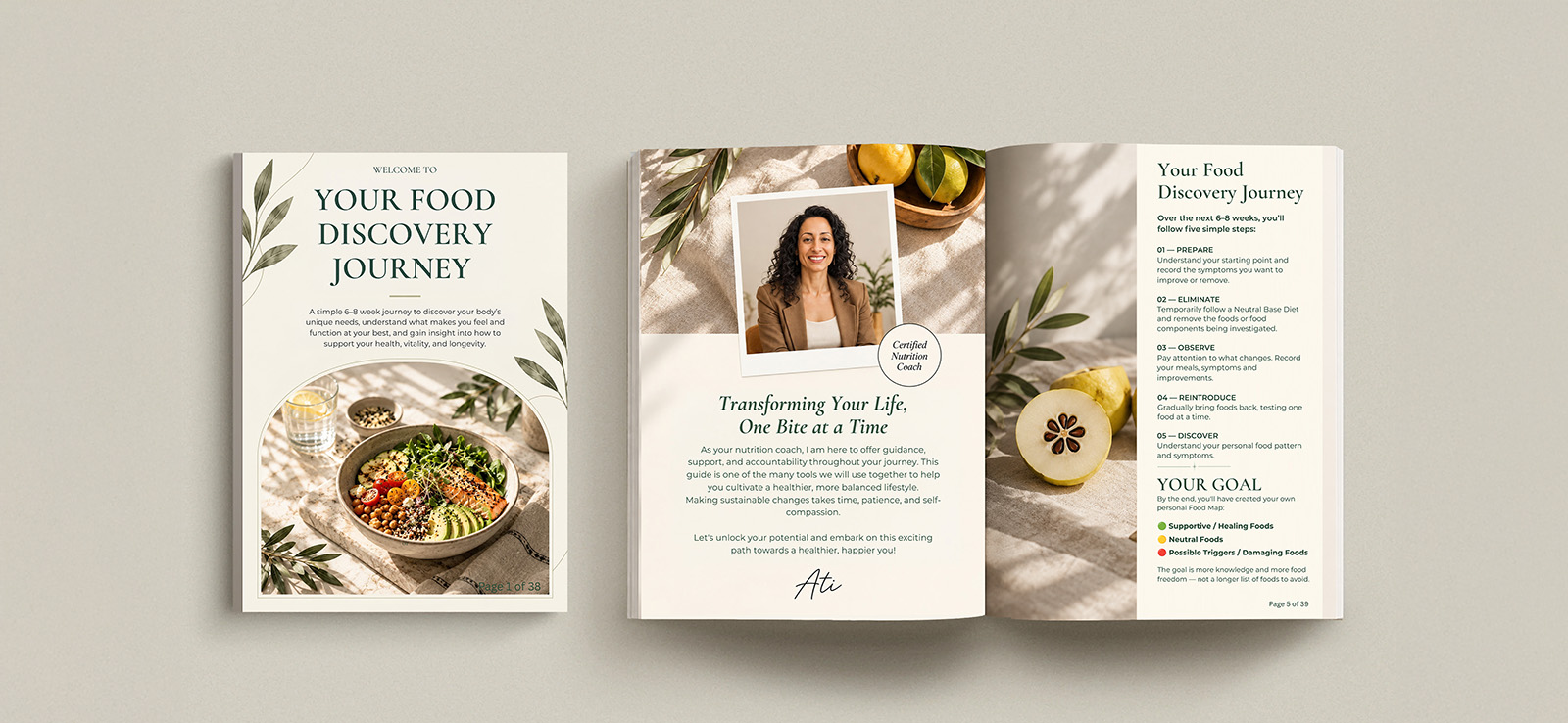
Instead of following another generic diet, you’ll work through a 6-8 week structured step by step guided process of observation, testing and reflection — helping you understand which foods may have a positive/healing effect for you, which ones are neutral, and which ones may have a triggering/damaging effect.
By the end, you’ll have something no generic diet can give you: a Food Map built around your own observations and experience.
You’ve Tried To Figure It Out. But You’re Still Guessing!
Is it the food I am eating?
Is it the quantity of it?
Is it the combination of certain foods?
Is it something else entirely
There is a clearer way.
The Food Discovery Guide gives you a structured process to slow down, observe your experience, and learn from your own patterns — rather than constantly starting over.
What you'll discover
No more:
Following endless food rules.
Jumping between conflicting advice.
Guessing which food caused what.
Removing foods without knowing what happens when you try them again.
You will start:
Following a structured step by step guided food journey plan
Testing one Food / Food Component at a time.
Observing your own patterns.
Recording what you notice.
Building a Food Map that’s personal to you:
Which foods consistently leave you feeling your best
Which foods may be connected to unwanted symptoms or changes
Patterns you probably wouldn’t notice without structured guided tracking
Your own “ideal / neutral / potentially triggering” Food Map
How It Works
Week 1-2
Prepare & Observe
Learn what to observe and begin tracking. This week is about getting to know your starting point with curiosity, not judgment.
Week 2-5
Establish Your Baseline
Follow the Neutral Base Diet and step-by-step guidance in your guide to establish your baseline while recording the symptoms outlined in your workbook.
Week 5-8
Reintroduce & Food Map
Bring everything together and start creating your personal Food Map — a practical guide to the foods that work for your body, based on real, direct experience.
What's included
The Food Discovery Guide A beautifully structured guide taking you through the entire process from preparation to final reflection.
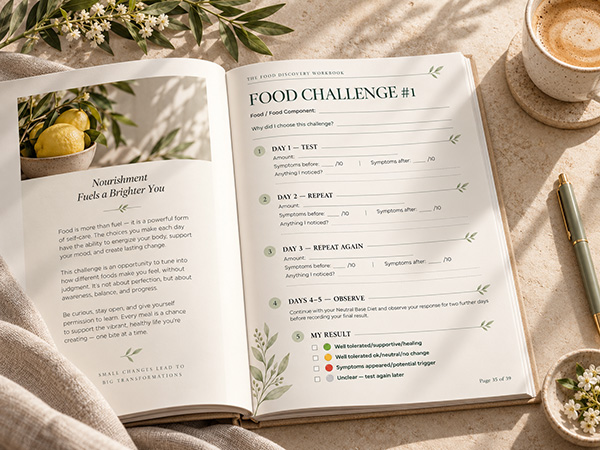
The Food Discovery Workbook Practical pages to record your starting point, symptoms, weekly observations, food challenges and discoveries – available in both printable and digital formats.
Weekly Guidance & Check-Ins Six weeks of weekly check-in and follow-up emails to help you stay on track, reflect on your progress, and move through each stage of your Food Discovery Journey.
1:1 Review with Ati If, after reading through the guide, you still have questions or need additional clarity and support, a 1:1 session can be arranged upon request.
I’m a UK-certified Fitness Coach and Nutritionist, as well as a certified Ayurveda Practitioner and Herbologist.
Over the years, I’ve dedicated myself to researching how different foods can affect different people, experimenting with food and lifestyle approaches, and working with clients internationally. Through years of observation, research, and experience, I began to connect the dots and develop a structured system designed to help you discover your individual food patterns, understand your unique needs, and create a Food Map that works for you, better than any other blood test, food sensitivity test, allergy test, skin-prick test, patch test, or other snapshot-based testing methods can do.
I believe our bodies have an incredible ability to find balance when we give them the right support. Rather than immediately looking outside the body for solutions, I believe we should first understand what our individual bodies need — including the foods and lifestyle choices that support us best.
This Food Discovery Journey is the system I developed to help you do exactly that: step back, observe, test, connect the dots, and discover what your body has been trying to tell you.
Suffering with back pain for a while and with Ati’s help, I’m currently pain-free. Very professional and definitely knows her trade very well. Highly recommend for anyone suffering with pain who needs intervention rather than just being given exercises to do at home and little else like some physios I’ve been to.
Ati, thanks for the wonderful Sport massage for me & my better half, we are very happy with the results. We as professional athletes we must keep always being checked by an excellent professional like you.
Many thanks
Amanda & Matthew
By far the most professional and thorough masseuse I have ever had the pleasure of visiting.
I see Ati regularly and she made the most impressive impression the first time I ever saw her.
With a slew of issues in toe surrounding my back, neck, shoulders and legs, Ati listened to my concerns and almost instantly honed in on the areas that required treatment and not only provided physical therapy and relief as a whole, but also knowledge and advice to manage my issues going forward.
Having tried other masseuses in the past, none have come close to the level of care and relief that Ati provides.
If you are looking for a proper treatment, with care, professionalism and thorough attention to detail and your wellbeing, don't look anywhere else and pay Ati a visit.
A great sports massage by ati
She is a true expert at what she does
Has helped my cramped muscles and made me feel altogether healthier
She is very committed to helping you
Thanks for your help
Today has been my 3rd sports massage with Ati and im very impressed with the service. I have a lot of massages maybe at least twice a month for the last few years. But something I have come to realise is that sports massages that Ati specialises in are very different from normal massages concentrating and working on different muscle groups with attention to detail leaving each muscle feeling de-stressed and all the knots slowly disappearing. Also I have some anxiety’s from time to time and this really really helps on calming the mind and resetting the body. I’m definitely going to have some more massages with Ati and would definitely recommend her thanks again.
Wow this woman is amazing and has truly transformed how my body is working. I’m so lucky to have found her and pleas note this is more than a sports massage because the knowledge and experience that Ati has encompasses many different techniques that she bespoke to her clients needs. I cannot recommend Ati enough as she has helped me so much and I feel it is my duty to share what great work she is able to do. Highly professional, calm, sensitive to the needs of her individual clients.I’ve been seeing Ati for several months and I can say 100% my physical well-being mobility, flexibility and pain levels have all been greatly affected in positive ways and I will continue to see Ati as my health improves to ensure that I maintain all my progress to date.
FAQ
What is the purpose of the 6–8 Week Food Discovery Guide?
The goal is to help you better understand how different foods may affect your body. By first establishing a stable baseline and then carefully reintroducing foods one at a time, you can observe patterns, identify potential triggers, and build your own personal Food Map based on your direct experience.
Do I need to follow the Neutral Base Diet exactly?
For the clearest results, it’s important to follow the Neutral Base Diet as closely as possible. This helps create a consistent baseline and makes it easier to identify how individual foods affect you during the reintroduction phase.
Is it vegan/vegetarian compatible?
Yes. The approach can be adapted to both vegan and vegetarian diets. Simply use the suggested alternatives in the guide to ensure you’re still meeting your nutritional needs while following the process.
What if I accidentally eat a food that isn’t on the Neutral Base Diet?
Don’t worry—one unplanned food doesn’t mean you have to start over. Simply record what you ate and any symptoms you notice, then return to the Neutral Base Diet and continue with the process. If this happens repeatedly, consider allowing an extra 3–4 days on the Neutral Base Diet before starting your food challenges to help ensure clearer, more accurate results.
What if my symptoms improve—or get worse—during the elimination phase?
This is valuable information to record. Continue tracking your symptoms as outlined in your workbook and look for patterns over time. Changes in your symptoms can help provide a clearer baseline before you begin reintroducing foods.
How do I know when I’m ready to start reintroducing foods?
Once you’ve followed the Neutral Base Diet for the recommended period and your symptoms have become stable enough to establish a clear baseline, you can begin the reintroduction phase. Use the step-by-step guidance in your guide to know when and how to start.
How do I reintroduce foods and record my reactions?
Follow the step-by-step food challenge process in your guide, introducing one food at a time. Record the food, amount, timing, and any symptoms or changes you notice in your workbook. This will help you build a clearer picture of how each food affects you.
What if I’m unsure how to interpret a reaction or what to do next?
Don’t worry—reactions aren’t always straightforward. Review your notes and the guidance in your workbook, and look for patterns rather than focusing on a single symptom or experience. If you’re still unsure or need additional support, a 1:1 session can be arranged upon request.
What if I don’t notice any changes during the process?
We all have foods that may not work well with our bodies, but the way they affect us can look very different from one person to another. For some, the response may be obvious; for others, it may be subtle and require closer attention. Without becoming too focused on every little detail, record what you notice—over time, patterns can reveal themselves and help you learn to decode your own body’s language.
Is it suitable if I have allergies/medical conditions?
The guide can be adapted around known food allergies, intolerances, or dietary requirements, but it is not a substitute for medical advice. If you have a diagnosed medical condition, food allergy, or are under medical care, please speak with your doctor or qualified healthcare professional before starting. Never intentionally reintroduce a food you know you are allergic to.
Is it digital?
Yes. The Food Discovery Guide is fully digital and can be accessed from your phone, tablet, or computer. The guide and workbook are also printable if you prefer to work with a physical copy.
What happens after purchase?
Once your purchase is complete, you’ll receive instant access to the Food Discovery Guide and accompanying workbook. You can download them, read through the guide, and get started whenever you’re ready.
We use cookies to improve your experience on our site. By using our site, you consent to cookies.
This website uses cookies
Websites store cookies to enhance functionality and personalise your experience. You can manage your preferences, but blocking some cookies may impact site performance and services.
Essential cookies enable basic functions and are necessary for the proper function of the website.
Name
Description
Duration
Cookie Preferences
This cookie is used to store the user's cookie consent preferences.